Eco Sponges vs Synthetic Brushes: Which Tool for Which Task?
The biodegradable sponge vs synthetic brush foundation comparison is not primarily a sustainability question. It is a materials question.
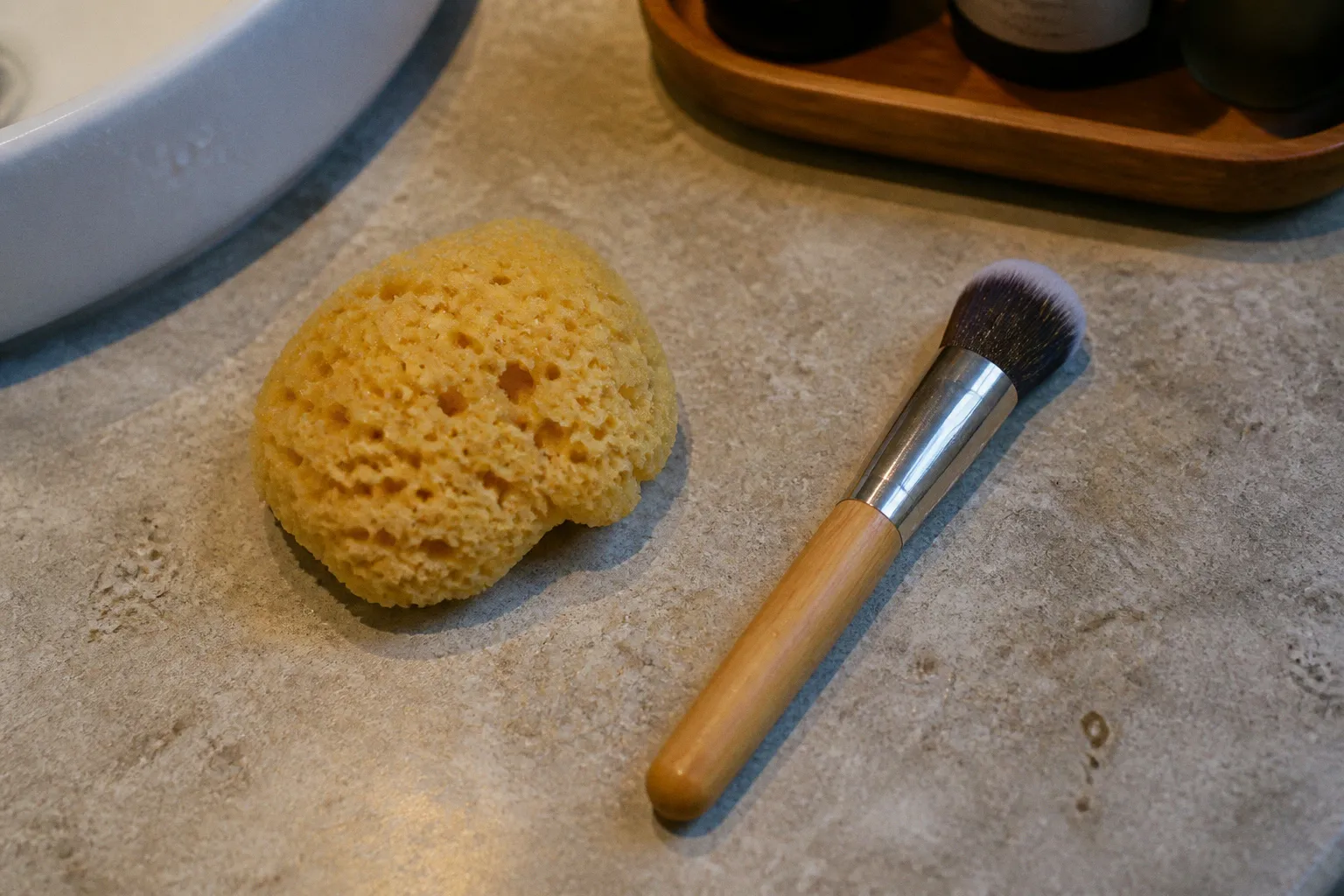
A synthetic foundation brush usually uses PBT or nylon bristles. These fibers are non-porous, resist liquid absorption, and retain their geometry over repeated use. A biodegradable makeup sponge uses a porous structure made from konjac, natural rubber, plant cellulose, or a bio-based polyurethane formulation. It interacts with foundation differently from the start.
The result is predictable. Synthetic brushes apply more product to the skin and reach medium to full coverage faster. Damp eco sponges reduce visible edges and produce a thinner, more diffused layer. Neither tool is universally superior. They optimize different performance variables.
The mechanics of application: PBT bristles versus plant-based porosity
A foundation brush transfers liquid makeup through contact between the bristle bundle and the skin. The bristles distribute the product across the surface. With a dense, flat, or rounded head, the tool can move foundation in a controlled direction and build coverage through additional passes.
PBT, or polybutylene terephthalate, is a common synthetic bristle material. Nylon is also used. Both are manufactured fibers with a relatively smooth, non-porous surface. They do not behave like a textile or natural hair fiber. Liquid foundation remains mostly on the exterior of the bristles until pressure and movement spread it across the face.
This has two practical consequences:
- The brush loses less liquid product into its structure than a porous sponge.
- The brush can be cleaned without retaining the same volume of foundation inside a deep network of absorbent fibers.
The phrase non-porous should not be interpreted as zero absorption. A brush can still retain product between bristles, inside the ferrule, or at the base of the head. Foundation viscosity also matters. A thick, silicone-heavy formula may cling to the bundle more strongly than a low-viscosity skin tint. The relevant comparison is lower retention, not absolute absence of retention.
A biodegradable sponge operates through compression and capillary absorption. When dry, the pores and channels inside the material can take up a substantial amount of liquid foundation. This is why a dry makeup sponge often produces higher product loss and a denser deposit on the skin.
Water changes the mechanism. A damp sponge contains water in its internal structure, reducing the available space for foundation to occupy. After excess water is removed, the sponge can press foundation onto the skin without taking the same quantity deep into the material.
The tool still absorbs some product. It simply absorbs less than it would in a dry state.
Material determines the first layer of performance: PBT keeps foundation near the surface, while a damp sponge distributes it through controlled compression.
Plant-derived materials do not share one universal texture. Konjac is soft and hydrophilic. Natural rubber has different elasticity and pore behavior. Cellulose formulations vary according to density and processing. Bio-based polyurethane can use plant oils in its formulation, but its environmental profile cannot be inferred from the phrase bio-based alone.
For this reason, a claim such as “plant-based” does not identify how a sponge will perform. Density, pore size, rebound, surface texture, and water retention are more useful performance data.
Finish and coverage: sheer blending versus full-coverage buffing
The central difference between these tools is not that one produces a better finish. It is that each tool creates a different distribution of foundation.
A brush deposits and moves product. A sponge presses and diffuses it.
With a synthetic brush, the first pass usually creates a more concentrated film. The brush can place product close to the nose, around the mouth, and along areas where higher coverage is required. A dense head gives more coverage. A looser head reduces the amount of product delivered per pass and can soften the result.
A damp sponge applies less foundation per contact point. Its bouncing or pressing motion breaks up visible edges. The foundation film becomes thinner and less directional. This is useful for sheer coverage, light tints, and formulas where brush movement leaves streaks.
The difference is especially apparent with fluid products. A low-viscosity skin tint can run along brush fibers and require deliberate blending. The same product can be pressed into a more uniform layer with a damp sponge. A dense foundation behaves differently. It may require a brush to distribute enough product before a sponge is used to soften the finish.
The following comparison is more reliable than broad claims about “natural” or “flawless” results.
| Parameter | Biodegradable makeup sponge | Synthetic foundation brush |
|---|---|---|
| Primary mechanism | Compression and diffusion | Surface distribution and buffing |
| Best coverage range | Sheer to light, with gradual building | Medium to full, with faster buildup |
| Product retention | Higher because of porous fibers | Lower because PBT and nylon are non-porous |
| Finish control | Softens edges and reduces visible transitions | Places product precisely and builds density |
| Speed | Slower when repeated pressing is required | Faster for broad-area application |
| Detail work | Good around curved areas when the tip is intact | Better for targeted placement and controlled coverage |
| Cleaning requirement | Must be rinsed thoroughly through the porous body | Requires washing through the bristle bundle and ferrule |
| Replacement pattern | Frequent; daily-use konjac sponges may last 4 to 6 weeks | Often multi-year when the head remains intact |
| Main limitation | Absorption, drying time, and internal contamination | Possible streaking, shedding, or product accumulation at the base |
The table also explains why a vegan makeup brush versus biodegradable sponge decision should begin with the desired finish. Vegan describes the absence of animal-derived materials. It does not guarantee low product absorption, long service life, or superior hygiene. A synthetic brush can be vegan and durable. A biodegradable sponge can be plant-derived but require frequent replacement.
The role of pressure
Pressure changes both tools.
On a brush, heavier pressure bends the bristles and increases the contact area. This can distribute product more quickly but may also create streaking if the formula begins to set before the surface is fully blended. Short, controlled strokes are usually more predictable than aggressive back-and-forth movement.
On a sponge, pressure compresses the pores. A hard bounce transfers product to the skin. Excessive pressure can remove foundation rather than add it, particularly when the formula is not fully set. A pressing motion produces more coverage than a light stippling motion. A rolling motion can disturb the layer underneath.
The sponge therefore offers finish control through compression. The brush offers coverage control through bristle density, angle, and movement.
Product efficiency and the absorption trade-off
Product waste is one of the strongest arguments for synthetic brushes. It is also one of the areas where marketing language becomes imprecise.
A non-porous synthetic brush generally absorbs less liquid foundation than a sponge. Most of the product remains accessible on the bristle surface. This supports faster application and lower tool-related loss. It also makes the brush suitable for expensive foundations, high-pigment formulas, and products used in small quantities.
A sponge has a different cost structure. It may use more foundation per application because some product enters the porous body. Wetting it first reduces this effect. A damp sponge is therefore the correct baseline for comparison. Comparing a dry sponge with a brush produces a result that is mechanically biased against the sponge.
The amount retained depends on several variables:
- Sponge density and pore structure.
- Foundation viscosity and oil phase.
- The amount of water remaining after wetting.
- Contact pressure and duration.
- Whether the sponge is used for pressing or dragging.
- How completely the tool is rinsed after use.
A very open sponge may load quickly and release product unevenly. A dense sponge can use less product but require more pressure to deform. Neither characteristic is automatically preferable. The correct match depends on the formula.
For liquid foundation, the most efficient workflow is often hybrid rather than exclusive. A brush can place and distribute the initial layer. A damp sponge can then reduce the appearance of brush marks and diffuse the perimeter. This approach uses the brush for transfer efficiency and the sponge for surface correction.
That does not make the sponge redundant. It makes its role narrower and more technically defined.
The least wasteful tool is not always the one with the smallest environmental claim. It is the one that delivers the required coverage with the fewest replacements and the least product loss.
The same principle applies to zero-waste makeup application tools. “Zero waste” is usually a directional description, not a literal operating condition. A sponge that must be discarded every few months creates a recurring material stream. A synthetic brush that lasts for years avoids frequent replacement but contains plastic fibers and a handle that may be difficult to recycle.
No universal carbon-footprint comparison can be made without data on manufacturing, transport, cleaning, packaging, disposal, and service life. The available material information does not establish that a bio-based sponge is environmentally superior in every use pattern.
The correct conclusion is narrower. A long-lasting brush reduces replacement frequency. A biodegradable sponge may reduce reliance on conventional petroleum-derived foams, depending on its material composition and disposal route. These are separate properties.
Lifecycle management: replacement, cleaning, and contamination
A foundation tool is a cosmetic applicator and a contamination reservoir. The material affects how contamination develops, but no material eliminates the need for cleaning.
Synthetic bristles have a surface that absorbs little liquid product. This limits the depth to which foundation can travel. However, product can accumulate between the fibers and near the ferrule. If the brush is not washed, the residue can mix with sebum, powder, pigment, and moisture from the skin.
The handle also matters. Bamboo handles are frequently paired with synthetic bristles in sustainable brush sets. Bamboo does not make the head biodegradable. It changes the handle material only. Recycled plastic handles have a different lifecycle profile, but neither option determines the hygiene of the bristle bundle.
A sponge is more demanding because its interior is porous. Foundation, oil, water, and skin debris can move below the surface. Rinsing only the exterior is inadequate. The tool should be washed through its entire body and allowed to dry completely in an open, ventilated location.
Replacing facial makeup sponges every 3 to 6 months is commonly recommended because dirt, oil, and potential bacteria can build up within porous fibers. Daily-use konjac sponges can have a shorter practical lifespan, often around 4 to 6 weeks, depending on use and drying conditions. The replacement window should be reduced if the sponge develops persistent odor, discoloration, surface cracking, or a texture change.
A sponge that looks intact can still contain material below the visible surface. Visual inspection is therefore not a complete hygiene test.
A brush has a longer potential service life. A well-made synthetic brush may remain functional for multiple years if the bristles do not shed excessively, the ferrule remains secure, and the handle does not crack. Longevity is not guaranteed by synthetic construction. It depends on fiber quality, adhesive, ferrule assembly, washing technique, and drying position.
Cleaning differences
The cleaning process should match the material.
For a synthetic brush:
1. Wet the bristles without saturating the handle or ferrule.
2. Work cleanser through the full bundle, including the base.
3. Rinse until the water runs clear and no slick film remains.
4. Reshape the head.
5. Dry horizontally or with the bristles angled downward.
For a sponge:
1. Saturate the entire body with clean water.
2. Apply cleanser to the sponge rather than only to the visible stain.
3. Compress and release repeatedly to move cleanser through the pores.
4. Rinse until no foundation-colored water remains.
5. Press out excess water without twisting the material.
6. Air-dry in an open area.
A clean brush cleanser can remove surface residue from synthetic fibers, but the cleanser must also be compatible with the adhesive and coating used at the ferrule. Strong solvents or prolonged soaking can weaken assembly components. A sponge cleanser must be rinsed more aggressively because residue left inside the pores can affect the next application.
Drying is part of the cleaning cycle. A damp sponge stored in a closed cosmetic bag creates a poor drying environment. The same principle applies to a wet brush placed bristle-down in a container. In both cases, the tool remains in prolonged contact with moisture.
Material claims and what they do not prove
Sustainable beauty tools are often categorized by a single material statement. That is not enough for a technical comparison.
Konjac
Konjac sponges are made from the root of the konjac plant, also known as elephant yam. The material consists of natural plant fibers and is commonly described as containing vitamins, proteins, lipids, and minerals including zinc and magnesium.
Those components identify the source material. They do not establish that the sponge provides a specific skincare benefit during foundation application. They also do not make the sponge equivalent to a cleansing treatment or a full-coverage applicator.
Konjac has a soft, absorbent structure. It is better suited to gentle pressing and light blending than to rapid, dense foundation buffing.
Natural rubber
Natural rubber provides elasticity and a different tactile response from cellulose or konjac. It can compress and rebound efficiently. The sustainability profile depends on sourcing, processing, additives, and the full product construction.
The term natural refers to the source of the rubber. It does not automatically indicate compostability in a specific waste system.
Plant cellulose
Cellulose is a plant-derived polymer used in various sponge structures. Its performance depends on how the fibers are bonded and how the pores are formed. A cellulose sponge may be soft and absorbent, but the label alone does not predict product retention.
Bio-based polyurethane
Bio-based polyurethane formulations can contain plant oils or other renewable feedstocks. The word bio-based refers to the origin of part of the formulation. It does not prove complete biodegradation.
Commercial composting compatibility is also not universal. Without manufacturer-specific testing, it is not possible to claim that every bio-based polyurethane sponge will fully break down in a home backyard compost bin or in every municipal composting facility.
This distinction is necessary because biodegradability, compostability, bio-based content, and low waste are not interchangeable terms.
| Claim | What it can indicate | What it does not establish |
|---|---|---|
| Plant-derived | Some raw materials come from plants | Full biodegradation or low total impact |
| Bio-based | A portion of the polymer uses renewable feedstock | Compostability in household conditions |
| Biodegradable | Material can break down under defined conditions | That those conditions exist in the user’s disposal system |
| Reusable | The tool can be used repeatedly | Long service life without hygiene or structural limits |
| Vegan | No animal-derived component is used | Low absorption, high durability, or environmental superiority |
For shoppers selecting eco-friendly makeup tools for liquid foundation, the most useful product information is therefore specific: material type, expected replacement period, washing instructions, drying requirements, and whether the manufacturer identifies a verified disposal route.
Optimizing the routine: when to use each tool
The decision becomes simple when the application task is defined before the sustainability claim.
Choose a synthetic brush when:
- The foundation must reach medium or full coverage quickly.
- The formula is expensive or highly pigmented.
- The product has a thicker viscosity and needs controlled placement.
- Coverage must be concentrated around redness, pigmentation, or the sides of the nose.
- The tool will be used frequently over a long period.
- Lower product retention is a priority.
- A reusable tool is preferred over a recurring sponge replacement cycle.
Choose a biodegradable sponge when:
- The desired result is sheer or light coverage.
- Visible edges need to be softened.
- The foundation is fluid and spreads unevenly with a brush.
- The product should be pressed into a thin surface film.
- The user is prepared to wet, wash, and dry the sponge after use.
- The replacement cycle is acceptable.
- The sponge has a defined material composition and disposal instruction.
A damp eco sponge is particularly effective as a finishing tool. Apply foundation with a brush, then use the sponge to press over areas where the layer looks too directional or concentrated. This reduces the need to use the sponge for the entire application and limits the amount of product entering its pores.
The reverse workflow also has a purpose. A sponge can create the initial sheer layer, while a synthetic brush adds product only where more coverage is required. This is useful with thin formulas that become patchy when repeatedly pressed.
The right method depends on the foundation’s setting time. A fast-setting formula can become uneven if brushed for too long. A slow-setting formula may remain movable and benefit from a brush’s controlled distribution. Product chemistry is therefore as relevant as tool material.
A practical selection matrix
| Application requirement | Preferred tool | Reason |
|---|---|---|
| Fast, even medium coverage | Synthetic brush | Higher transfer efficiency and controlled distribution |
| Soft, sheer coverage | Damp biodegradable sponge | Lower-density deposition and edge diffusion |
| Building coverage around the nose | Synthetic brush | Precise placement and easier local buildup |
| Reducing visible brush marks | Damp sponge | Pressing softens directional marks |
| Minimum liquid foundation retention | Synthetic brush | Non-porous PBT or nylon fibers retain less product |
| Lowest replacement frequency | Synthetic brush | Potential multi-year service life |
| Plant-derived disposable or semi-disposable option | Material-specific sponge | Possible use of konjac, cellulose, rubber, or bio-based polyurethane |
| Hybrid application | Brush followed by sponge | Efficient placement with a softer final film |
The comparison is not a contest between conventional and sustainable beauty. Synthetic bristles can be vegan. A bamboo-handled brush can combine a renewable handle with plastic fibers. A biodegradable sponge can reduce dependence on conventional foam but require repeated replacement. The environmental result is determined by the complete use pattern.
That includes how often the tool is used, how much foundation it consumes, how long it lasts, how it is cleaned, and what happens after disposal.
The final verdict
For foundation application, the synthetic brush is the better primary tool when coverage, speed, product efficiency, and long service life are the decision criteria. PBT and nylon bristles keep most liquid product near the surface, provide controlled placement, and can remain functional for multiple years.
The biodegradable sponge is the better secondary tool when the target is sheer coverage, a diffused edge, or a softer surface distribution. It should be used damp. Its porous structure requires more rigorous cleaning and more frequent replacement. Konjac sponges used daily may last roughly 4 to 6 weeks, while facial makeup sponges are commonly replaced within 3 to 6 months.
The binary answer is clear: choose the synthetic brush for efficient coverage; choose the biodegradable sponge for diffusion and finish correction. If sustainability is the deciding factor, compare the full lifecycle rather than the label. A material claim is not a performance metric, and a biodegradable component is not proof of zero-waste makeup application.