Magnetic eyelashes for sensitive eyes: are they worth the hype?
If lash glue leaves your eyelids red, itchy, swollen, or generally furious by the end of the night, magnetic eyelashes look like the obvious escape route. No cyanoacrylate adhesive. No latex-based strip glue.

No wrestling with a sticky lash band while one eye waters through your entire look.
But “glue-free” is not the same as “risk-free.” Magnetic eyelashes replace one set of problems with another: iron-oxide-based eyeliner, pressure from sandwich-style lash strips, possible eyelid irritation, lash breakage, and one hard stop that should never be ignored—MRI safety.
So, is a magnetic eyelashes kit for sensitive eyes worth it? Sometimes. The right kit can be a genuinely useful alternative to traditional falsies, especially if adhesive is your main trigger. The wrong kit can turn a clean, dramatic eye look into a creasing, tugging, itchy mess with a side order of broken natural lashes.
The performance question is not whether magnets sound clever. It is whether the specific system gives you enough visual payoff without creating more stress around the eye.
Magnetic lashes solve the glue problem. They do not delete the biology of your eyelids.
The chemistry of attraction: what is actually holding the lash on?
There are two dominant magnetic lash systems, and confusing them is where many disappointing purchases begin.
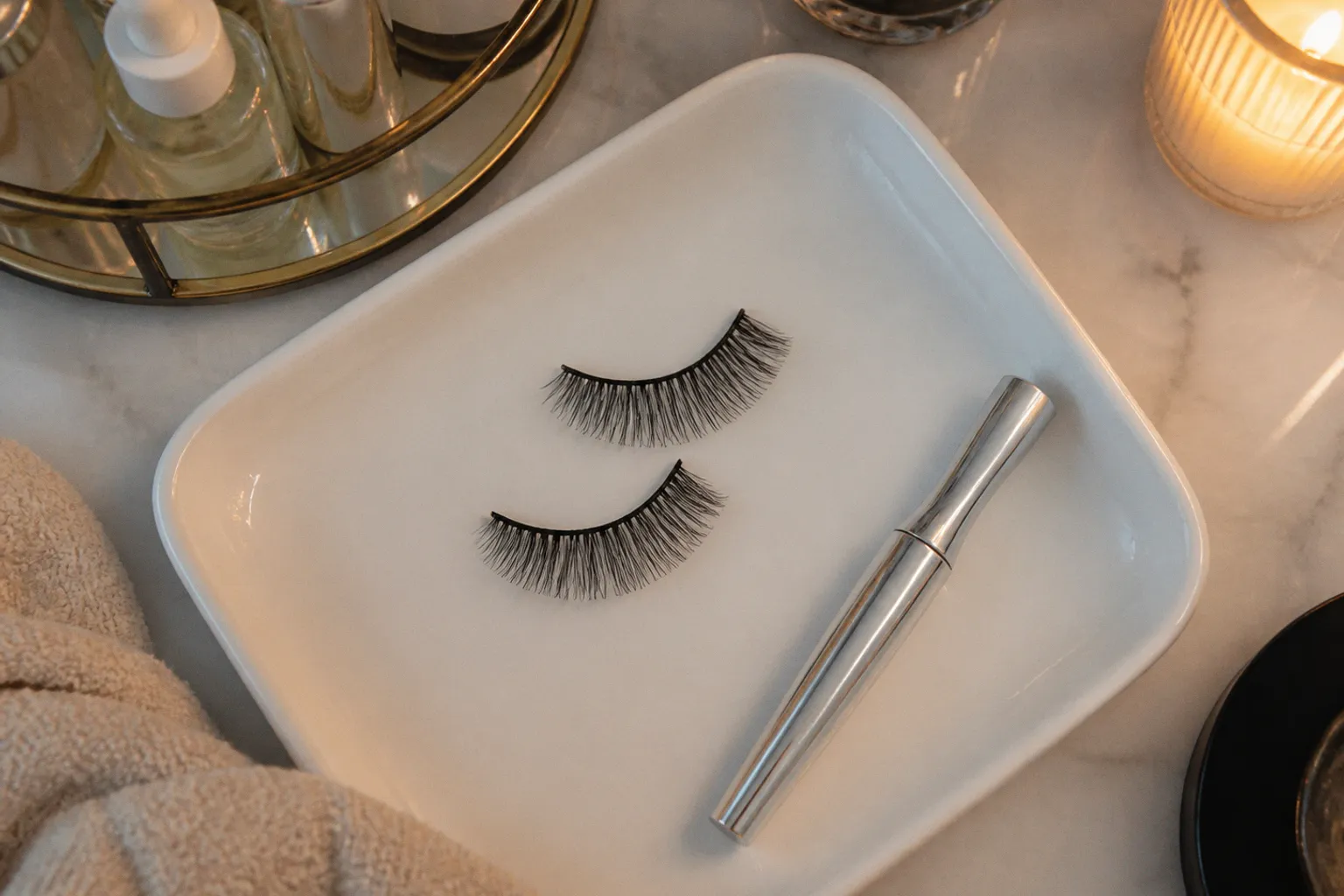
The first uses a magnetic eyeliner. You apply a dark liner along the lash line, allow it to set, then place the false lash on top. The lash band contains small magnets that adhere to the iron-oxide particles in the liner.
The second is the sandwich or clip style. One lash strip sits above your natural lashes and a second magnetic strip sits beneath them. The two pieces clamp together around your own lashes.
They look similar in product photography. They do not behave similarly on the eye.
Magnetic eyeliner typically offers a cleaner visual line because the liner becomes part of the eye makeup. It can also disguise the lash band, which matters when you want a defined, high-impact shape rather than a visible strip floating above the lid. The trade-off is direct skin contact with the formula. If your eyelids react to pigments, preservatives, or other ingredients, the “glue-free” advantage may not feel like much of an advantage.
The active magnetic component in these liners is synthetic iron oxide. In the United States, cosmetic-grade synthetic iron oxide used in eye cosmetics is regulated by the FDA under 21 CFR §73.2250. That tells you the ingredient has a defined regulatory framework. It does not mean every formula will agree with every eyelid.
Cosmetic-grade iron oxides are generally considered low hazard in cosmetic safety databases, including a score of 2 in EWG Skin Deep’s assessment. That is reassuring at the ingredient-class level, but your skin does not read databases. It reacts—or does not react—to the finished formula sitting against it for hours.
Magnetic eyeliner versus sandwich-style lashes
| Factor | Magnetic eyeliner system | Sandwich-style magnetic lashes |
|---|---|---|
| Main contact point | Eyelid skin and lash line | Natural lashes between two magnetic strips |
| Adhesive required | No traditional lash glue | No traditional lash glue |
| Main irritation concern | Formula, pigment, liner ingredients | Pressure, friction, strip edges, removal |
| Ease of hiding the band | Usually better | Depends heavily on strip alignment |
| Best visual control | Stronger for precise placement | Faster once mastered, but less forgiving |
| Risk to natural lashes | Mostly from removal or rubbing | More directly linked to clamping and traction |
| Main failure mode | Smudging, creasing, liner irritation | Pinching, slipping, lash breakage |
| Removal | Lift lash, then remove liner gently | Separate strips without pulling the natural lashes |
The practical difference is simple: eyeliner systems place the burden on your eyelid skin; sandwich systems place it on your natural lashes. Neither is automatically the better choice. You are choosing which contact point is less troublesome for your particular sensitivity.
The real benefit: removing glue from the equation
Traditional lash adhesives can contain cyanoacrylate compounds or latex, both of which are common triggers for eyelid contact dermatitis and allergic reactions. If your eye makeup history includes burning, swelling, or delayed redness after false-lash application, removing adhesive from the routine is a meaningful change—not marketing confetti.
This is where magnetic lashes have their strongest case.
A magnetic lash kit can be useful when:
- lash glue consistently causes irritation;
- you need a reusable strip for occasional high-impact makeup;
- you want to remove lashes without dissolving adhesive along the lash line;
- you struggle to position a wet, tacky strip before the glue starts setting;
- you prefer a clean beauty routine that avoids traditional lash adhesive.
There is also a psychological advantage. You are less likely to over-apply product when the lash is not depending on a thick, perfectly placed glue line. That can make application feel less chaotic, particularly when you are working around sensitive or watery eyes.
But do not confuse reduced chemical exposure with universal comfort. A magnetic liner can still sting. The liner may crease into the fold, transfer onto the upper lid, or leave a rigid film that becomes unpleasant as the day progresses. If your eyelids are reactive, the formula is part of the product—not an afterthought.
And if the issue is active blepharitis, an eye infection, or unexplained inflammation, a magnetic lash kit is not a workaround. Decorative eye products should wait until the underlying problem has been assessed and settled.
Sensitive eyes still need a patch test
The patch test is not glamorous. It is also considerably less dramatic than discovering a new eye product by coating your lash line before an event.
For a magnetic eyeliner system, test the formula on a small area of skin away from the eye first. The inner forearm is a common screening location, though eyelid skin is more delicate and can respond differently. Apply a small amount according to the product directions, let it remain for the recommended wear period, and monitor for redness, itching, burning, or swelling.
A clean result does not guarantee perfect eye tolerance. It does, however, give you more information than charging directly into a full lash application with a product you have never worn.
When testing, look for two kinds of reaction:
1. Immediate discomfort: stinging, burning, watering, or a sharp sensation soon after application.
2. Delayed irritation: redness, itchiness, swelling, flaking, or tenderness that appears later or after removal.
Do not “push through” either one because the lashes look good. A dramatic eye is not worth turning your eyelid into a complaint department.
If you have a known sensitivity to iron oxides or have reacted to magnetic eyeliner before, choose a different system rather than assuming a new package design has solved the chemistry. Formulas vary, but the magnetic mechanism still depends on iron-oxide pigment.
Why the word “hypoallergenic” needs skepticism
Marketing language around sensitive eyes is often impressively confident and scientifically underdressed. “Hypoallergenic” does not mean non-allergenic. It generally signals a lower expectation of causing reactions, not a guarantee that your skin will accept the formula.
The useful information is on the ingredient list and in the application design:
- Is the eyeliner fragrance-free?
- Does the product disclose its full ingredient list?
- Is the liner intended for use directly along the lash line?
- Does the kit rely on a very thick film to hold the lash?
- Can the lash be removed without dragging across the lid?
- Are the magnets enclosed securely in the lash band?
A clean beauty label may help you narrow your options, but it is not a medical certification. “Vegan,” “cruelty-free,” and “non-toxic” describe different things, and none of them replaces a patch test.
Sensitive eyes do not need a more persuasive label. They need fewer failure points.
Mechanical damage: the hidden cost of the no-glue pitch
The more aggressive risk with sandwich-style magnetic lashes is not usually the magnet itself. It is the clamp.
When the upper and lower strips are aligned correctly, the system can sit securely without glue. When they are misaligned, too heavy, too tight, or repeatedly repositioned, the pressure lands on your natural lashes. That can mean pinching at the lash base, friction along the hair shaft, and traction when the strips are removed.
Traction alopecia is the technical term for hair loss caused by repeated pulling or tension. Around the eye, the mechanism is not mysterious: if the lash sandwich grips your natural lashes and you force it off, the natural lashes can come with it. Compressive magnetic lashes can also contribute to mechanical breakage when the system is worn or removed roughly.
This is not a reason to panic over one careful application. It is a reason to stop treating the lash kit like an indestructible accessory.
The removal test matters more than the application demo
Most product demonstrations focus on getting the lash on. That is the easy half of the deal. A kit earns its place by coming off without a tug-of-war.
For sandwich lashes:
1. Separate the magnetic strips with your fingers rather than pulling the entire assembly away in one motion.
2. Release the magnets gradually along the band.
3. Do not drag the strip sideways through your natural lashes.
4. If the lash is stuck, stop and reposition your fingers.
5. Never use force simply because the product is marketed as easy removal.
For magnetic eyeliner:
1. Lift the false lash from the outer edge with clean fingers.
2. Use an appropriate eye-makeup remover to soften the liner.
3. Avoid scraping the lash line with nails or a rigid tool.
4. Remove residue gently rather than rubbing until the skin feels raw.
5. Clean the lash band before storage if the product instructions allow it.
A lash that survives ten applications but costs you a handful of natural lashes each time is not durable. It is merely reusable in the most technical, least useful sense of the word.
The 12-hour pressure test: where magnetic lashes usually reveal themselves
Expressive eye makeup is rarely judged after five comfortable minutes in front of a mirror. The actual performance test is a long day, warm lighting, movement, humidity, watery eyes, and repeated blinking.
Under those conditions, magnetic lashes tend to fail in predictable ways.
1. The liner begins to crease
Magnetic eyeliner has to remain tacky or magnetically responsive enough to hold the lash. If it sets too wet, it may transfer. If it dries too rigid, it can crack along the fold. On hooded lids, the liner may rub against the upper skin with every blink.
A thick line can improve hold but worsen texture. That is the central compromise: more product may mean more magnetic contact, but it also means a heavier, more visible, potentially more irritating film.
2. The inner corner lifts
The inner corner is a hostile environment for false lashes. There is curvature, movement, moisture, and very little spare lid space. If the lash band is too long or too stiff, it will lift there first.
A lifted inner corner is not just a cosmetic annoyance. It catches, itches, and invites repeated touching. Repeated touching creates more irritation and transfers more product. The cycle is ugly and completely avoidable.
3. The strip feels heavy
Large, dramatic lashes produce visual impact by adding density and length. They also add weight. If your natural lashes are fine or sparse, a heavy magnetic strip may feel like a tiny structural beam attached to a very delicate roof.
For a sensitive-eye kit, look for a lightweight band and a lash shape that builds impact through placement rather than excessive bulk. A dense, stiff strip may look spectacular in the box and become exhausting after several hours.
4. The lash shifts instead of falling off
A complete lash failure is obvious. Micro-slippage is more common and more irritating. The outer corner moves a few millimeters. The band no longer follows the liner. One eye begins to look more lifted than the other.
This is where cheap magnetic systems lose the plot. The product may technically remain attached while the visual structure becomes muddy. A professional eye look depends on symmetry, clean negative space, and a controlled outer edge. “Still on” is not the same as “still performing.”
5. Watery eyes compromise the system
Sensitive eyes may water because of the product, the environment, or the sheer presence of a foreign strip. Moisture can weaken the visual neatness of the liner and encourage slipping. It can also lead you to rub, which is disastrous for both makeup and lash retention.
If your eyes water easily, prioritize a secure but light design. A heavy lash that requires constant correction is not a sensitive-eye solution. It is an additional stimulus.
MRI safety is not a footnote
Magnetic eyelashes should not be worn during an MRI scan.
This applies to both magnetic eyeliner systems and sandwich-style magnetic lashes. The magnetic components can interact with the MRI’s powerful magnetic field. The American Academy of Ophthalmology warns against wearing magnetic false eyelashes during MRI procedures, and a 2020 study using a 3-Tesla MRI scanner and ASTM F2052-15 testing standards found strong translational forces capable of creating serious deflection hazards.
That is not a beauty inconvenience. It is a hard safety boundary.
Tell the imaging staff that you are wearing magnetic eye products, and remove them before entering the MRI environment. Do not rely on the product’s “small magnets” claim. The issue is not whether the magnets feel powerful in your hand. The issue is how they behave in a high-strength magnetic field.
If you have a scan scheduled, avoid applying magnetic lashes beforehand. Removing a stubborn liner in a hospital changing area is an unnecessary complication, and leaving it on is not an acceptable gamble.
Choosing the right system for your eye sensitivity
There is no universal winner between eyeliner-based and sandwich-style magnetic lashes. The better option depends on whether your skin or your natural lashes are more likely to object.
Choose magnetic eyeliner when:
- adhesive is your main source of eyelid reactions;
- your natural lashes are fragile or sparse;
- you want a more concealed lash band;
- you can tolerate eyeliner formulas along the lash line;
- you are willing to patch test and remove the liner carefully.
Choose sandwich-style lashes when:
- you react to multiple eyeliner formulas;
- you prefer to keep pigment away from the eyelid;
- your natural lashes are strong enough to tolerate light clamping;
- you can remove the strips without pulling;
- you are comfortable with a slightly more technical application.
Be cautious with either style when:
- your eyelids are currently inflamed;
- you have active blepharitis or an eye infection;
- your eyes are frequently watering without a clear reason;
- your lashes are already breaking or thinning;
- you have a known reaction to iron oxides or magnetic liner ingredients;
- you are likely to sleep, exercise, or swim in the lashes.
Magnetic lashes are not designed to become invisible permanent fixtures. They are a cosmetic system for controlled wear. The longer you keep a foreign strip, pigment film, or clamp on the eye, the more opportunity there is for irritation and mechanical trouble.
Are magnetic lashes worth it for long-term use?
The answer depends on what you mean by long-term.
If you mean repeated occasional use with careful application, gentle removal, and no signs of irritation, a magnetic lash kit can be a practical part of an expressive eye makeup routine. It may reduce your exposure to lash adhesive and offer more predictable placement than traditional glue-on strips.
If you mean wearing the same system constantly, ignoring discomfort, or treating reuse as proof that the kit is harmless, the answer is no.
There is limited basis for making sweeping claims about the long-term effects of magnetic eyeliner across every brand and formula. The confirmed concerns are more immediate and more practical:
- eyelid irritation from the formula;
- sensitivity to synthetic iron oxide or other ingredients;
- mechanical lash breakage;
- traction from compressed natural lashes;
- problems caused by forceful removal;
- MRI-related hazards.
The product’s lifespan also depends on cleaning and storage. A lash band that accumulates liner, oil, dust, and skin debris becomes less pleasant to wear and harder to position cleanly. Reuse is only a benefit if the kit remains hygienic and structurally intact.
Inspect the magnets and lash band before each application. If a magnet is loose, exposed, or no longer seated correctly, retire the lash. If the band has warped, the risk of lifting and friction rises. If the liner has changed smell, texture, or consistency, do not revive it with wishful thinking.
The final verdict
A magnetic eyelashes kit for sensitive eyes is worth considering when traditional lash glue is the clear villain. The glue-free design can reduce exposure to common adhesive triggers, and magnetic eyeliner systems can deliver a sharp, high-impact lash line without the usual sticky application drama.
But magnetic lashes are not automatically gentler. Eyeliner-based kits shift the risk toward formula-related irritation. Sandwich kits shift it toward pressure, friction, and traction on natural lashes. Both require disciplined removal. Both must come off before an MRI. Neither belongs on an inflamed or infected eye.
My verdict: choose magnetic eyeliner if your natural lashes are fragile but your skin can tolerate the formula; choose a lightweight sandwich system only if your eyelid is the more reactive zone and your lashes can handle the clamp. Patch test first, keep wear controlled, and reject any kit that needs force to remove or a thick, muddy layer of product to stay attached.
The hype is not completely hollow. The technology solves a real problem. It just does not solve every problem in the eye area—and the kits that perform best are the ones designed around that fact.