Biodegradable makeup sponges: our 30-day wear test
Look at the blender in your makeup bag right now. No, really — take it out and look. If you've had it longer than thirty days, it may be carrying weeks of foundation residue, skin oils, water, and whatever else has accumulated between washes.
We both know how this happens. The egg sits there, soft and sad, slightly discolored, half-disintegrated at the edges, and we keep using it because replacement blenders cost money and tossing a still-functional tool feels wasteful. The whole relationship is a mess.
The new wave of biodegradable makeup sponges wants to rewire that dynamic. Thirty-day lifecycle: use it, wash it, let it dry, replace it, compost it. No landfill guilt and no five-year-old sponge you've become emotionally attached to. The pitch — and the part that makes this category genuinely interesting — is that plant-based foam can deliver a workable month of makeup application before it reaches the end of its intended service life.
That's a bold claim. So we looked at the documented thirty-day wear scenario through the lens that actually matters: how the material holds together, how the application changes with repeated use, what cleaning does and does not solve, and whether the sponge has a credible end-of-life route beyond the trash.
A compostable sponge isn't just a greener version of the same egg — it changes the material, the replacement logic, and what happens after the last application.
The Anatomy of a Compostable Blender: Beyond Petroleum-Based Foam
Let's be precise about what we're replacing. The classic beauty blender — that egg-shaped tool found in almost every makeup kit — is usually made from open-cell polyurethane foam. It expands when damp, holds water and product in its cells, and gives you that familiar soft bounce during application. It can feel luxurious when new and progressively less convincing as the foam becomes stained, less springy, or damaged by repeated washing.
None of that automatically makes a synthetic sponge a bad tool. Polyurethane is popular because it is consistent, resilient, easy to manufacture, and capable of producing a smooth finish. The environmental problem appears at the other end of the relationship. A conventional polyurethane sponge is not biodegradable, so a discarded one remains a long-lived piece of synthetic waste.
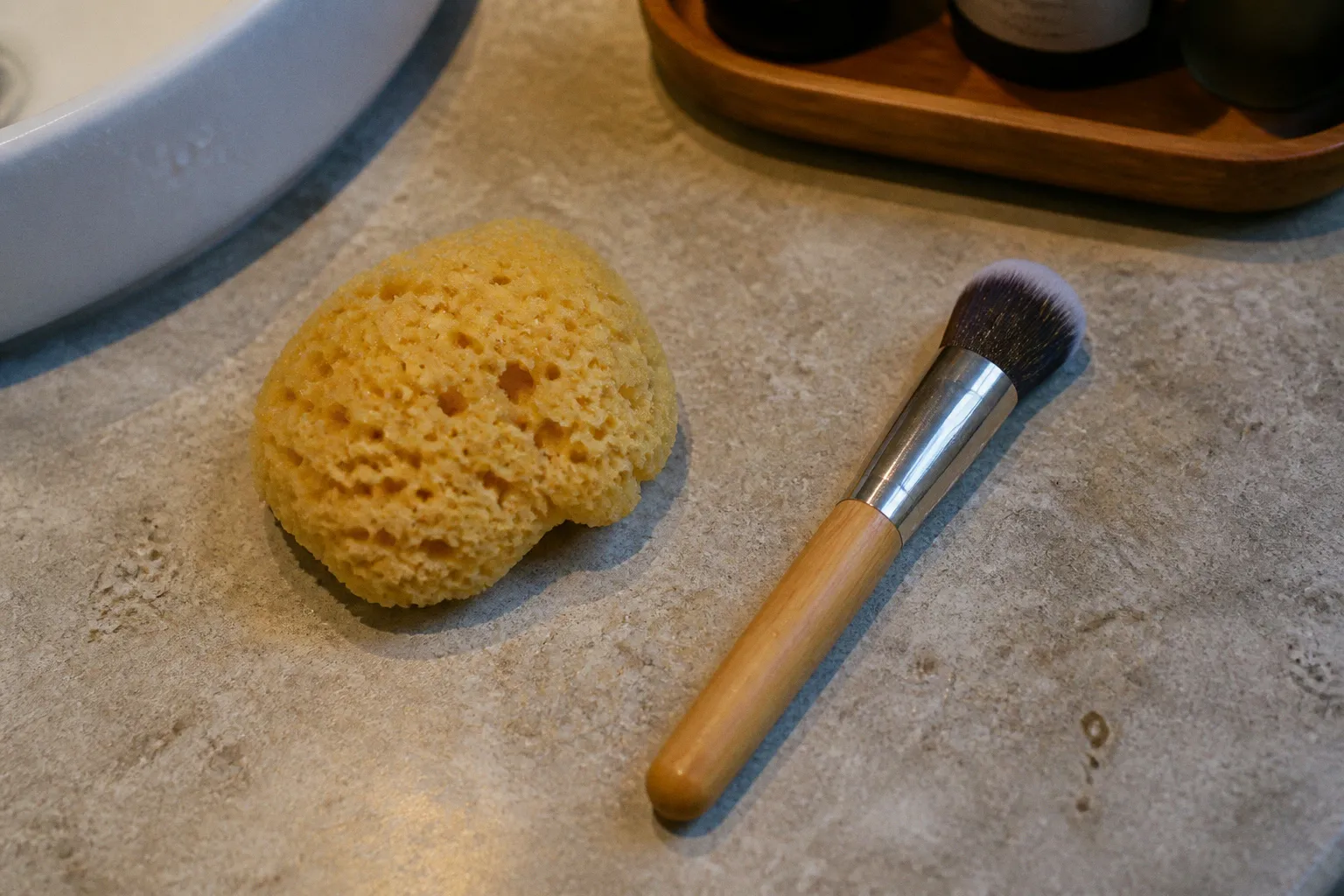
A genuine biodegradable makeup sponge takes a different route. The EcoTools BioBlender, for example, was presented as a 100% plant-based option made from five listed ingredients: water, corn, bionanopol, natural preservatives, and natural pigment. The important distinction is not the word natural on the front of the package. It is the absence of a petroleum-based polyurethane backbone.
Bionanopol is the structural workhorse in this formulation. It is a plant-derived polymer designed to create a flexible, open-cell material that can be dampened, squeezed, and pressed into the skin without immediately collapsing. In practical terms, the goal is familiar performance from a different feedstock: enough porosity to hold water, enough resilience to bounce back, and enough surface softness to diffuse foundation rather than drag it across the face.
That last point matters more than the ingredient list. A makeup sponge is not judged in the abstract. It is judged while holding liquid foundation, releasing excess water, navigating the sides of the nose, and surviving the particular violence of being squeezed into a towel after washing. A plant-based material can be more sustainable on paper and still be a poor beauty tool if the cell structure breaks down too quickly.
Then there is the muddy middle ground: partial-bio sponges that combine roughly 60% renewable sugarcane material with 40% traditional polyurethane foam. These products can reduce the amount of petroleum-based material, but the synthetic component remains. They are not equivalent to a fully compostable sponge, and “bio-based” does not necessarily mean “home compostable.” The back of the package matters more than the green packaging.
| Material type | Composition | Home compostable? | What happens at end of life |
|---|---|---|---|
| Classic polyurethane blender | Petroleum-based polyurethane foam | No | The synthetic foam remains in the waste stream |
| 100% plant-based BioBlender | Water, corn, bionanopol, preservatives, pigment | Yes, under suitable home-composting conditions | Intended to break down in an active compost environment |
| Partial bio-based sponge | Roughly 60% sugarcane material and 40% polyurethane foam | No, because the PU fraction remains | Plant-based components may degrade while the synthetic structure persists |
Composition also affects what you feel in the hand. Synthetic foam often has a very predictable rebound: wet it, squeeze it, and you know almost exactly how it will behave. Plant-based foam may feel slightly different in density or surface drag, especially when it is fully saturated. That is not necessarily a flaw. It simply means “same shape” does not mean “same tool.”
Performance Under Pressure: The 30-Day Wear and Tear Analysis
A sponge that feels luxurious for one application is meaningless if it cannot survive a month of regular use. The relevant question is not whether a plant-based beauty blender looks perfect straight out of the packet. It is whether it remains usable after repeated wetting, squeezing, washing, drying, and contact with complexion products.
The documented thirty-day wear scenario suggests that fully plant-based sponges can maintain their basic structural integrity across the intended cycle. They do not dissolve during ordinary application. They do not turn into a soft puddle after a few damp uses. They remain recognizable as a makeup tool rather than becoming a disposable piece of packaging.
But “holds together” is a low bar. Application performance is more revealing. In a durability test, I would separate the question into four areas:
- Shape retention. Does the pointed end still reach the inner corner and sides of the nose? Does the rounded base still distribute product evenly across the cheeks and forehead?
- Bounce. Does the sponge compress and recover without feeling flat or exhausted?
- Surface condition. Does the foam remain smooth enough for a seamless finish, or does it become fibrous and uneven?
- Washability. Can product be removed without excessive scrubbing, tearing, or permanently deforming the material?
The first signs of wear are usually functional rather than dramatic. An edge may lose some definition. The tip may feel less precise after repeated contact with concealer and setting products. The surface can become slightly less even, particularly in the areas used most often. None of these changes means the sponge has suddenly failed. They mean the tool has moved away from its best performance.
What repeated use changes
A fresh sponge has a clear, springy response. It expands evenly when damp and gives a controlled amount of pressure under the fingers. That makes it easy to switch between tapping in foundation with the broad side and placing concealer with the tip.
With continued use, several small changes can accumulate:
- Edge degradation: defined edges can become rounder, making sharply placed contour or precise under-eye work less exact.
- Micro-tears: repeated squeeze-and-release cycles may create small fissures, especially if the sponge is wrung out aggressively or pulled apart while being cleaned.
- Density changes: the foam can feel softer or less responsive, which affects how quickly it pushes product into the skin.
- Texture drift: a surface that started smooth may become slightly more fibrous, particularly around the pointed end.
- Staining: pigment left in the cells can make it harder to judge whether the sponge is genuinely clean, even after washing.
These are the same kinds of practical questions that apply to any applicator. The difference is that the plant-based version is designed around a shorter, more deliberate use period. The purpose is not to promise that the sponge will perform like new indefinitely. It is to make a month of useful performance compatible with a less persistent end-of-life material.
The important editorial distinction is between documented durability and a rigid performance calendar. A sponge does not necessarily become unusable on a particular day, and it will not wear at the same pace for everyone. Someone who uses it once or twice a week with a light skin tint is putting it under less pressure than a makeup artist using full-coverage foundation, cream contour, concealer, and setting products every day.
The thirty-day mark works best as a replacement framework, not a prediction that every sponge will look identical on day thirty. Check the actual tool. If the surface is splitting, the smell remains after washing, the shape no longer returns, or the application has become patchy, it is finished. If it still appears sound, the hygiene and care routine still matter more than sentimentality.
Day thirty is a sensible boundary for a disposable tool, not a magical moment when every sponge stops working at once.
Application payoff versus material wear
The phrase “seamless finish” can hide a lot of variables. Foundation formula, skin preparation, the amount of water left in the sponge, and the pressure of application all change the result. A sponge that seems too absorbent with a thin skin tint may be excellent with a thicker cream foundation. A sponge that gives a softly diffused cheek may be less helpful when you need a clean contour edge.
For this reason, the durability question should be framed in terms of consistency. Does the plant-based sponge continue to give you a predictable finish as it ages? The documented wear scenario points to a qualified yes: the sponge remains usable throughout the intended period, while its precision and spring can gradually become less distinct.
That is a more credible result than pretending there is no trade-off. A tool can meet its thirty-day purpose without remaining indistinguishable from a brand-new synthetic blender. The realistic expectation is a gradual decline in responsiveness, not sudden disintegration.
The Hygiene Reality: Plant-Based Does Not Mean Self-Cleaning
Now for the unglamorous part that sustainability marketing often leaves in the margins: a biodegradable sponge still touches your face, your makeup, your hands, and water. It can retain moisture and cosmetic residue just as any porous applicator can. The material’s origin does not remove the need for cleaning.
Every time you dampen a sponge, press it into foundation, tap it across the skin, and put it into a pouch or drawer, you create an opportunity for residue and moisture to remain in the cells. A closed makeup bag slows drying. Heavy complexion products are more difficult to rinse completely than a sheer tint. A sponge that looks clean on the outside can still hold pigment deeper in the material.
There is no useful reason to make a precise week-by-week microbiology claim here. The rate of buildup depends on how often the sponge is used, how thoroughly it is washed, how quickly it dries, the products applied to it, and the conditions in which it is stored. What can be said with confidence is simpler: repeated use without proper cleaning increases the amount of residue in the sponge, and a damp, poorly ventilated storage situation is not a good one for any porous tool.
Plant-based materials do not change that basic hygiene reality. They are not automatically antibacterial. They are not self-cleaning. They should not be treated as safer merely because they are compostable. “Natural” describes the source of some of the material; it does not describe what happens after the sponge has been used on the skin.
A sensible care routine is straightforward:
- Wash the sponge after each use when possible, particularly after using cream or liquid complexion products.
- If daily washing is impractical, clean it thoroughly and regularly rather than allowing several layers of residue to build up.
- Use a cleanser that can lift makeup without requiring violent twisting or repeated pulling.
- Rinse until the water runs clear and the foam no longer feels coated.
- Press out excess water with a clean towel instead of wringing the sponge into a distorted shape.
- Let it dry fully in an open, ventilated place before putting it into a pouch or drawer.
- Retire it earlier if it develops persistent odor, visible mold, deep cracks, or a surface that no longer rinses clean.
The care routine is not a minor footnote. It affects both hygiene and durability. Aggressive cleaning can shorten the life of a plant-based makeup sponge just as surely as leaving it wet can make it unpleasant to use. The goal is not to preserve the tool forever. The goal is to keep it clean and functional for the period it was designed to serve.
Lifecycle Impact: From Your Vanity to the Home Compost Bin
This is where the marketing gets loud and the documentation gets thinner.
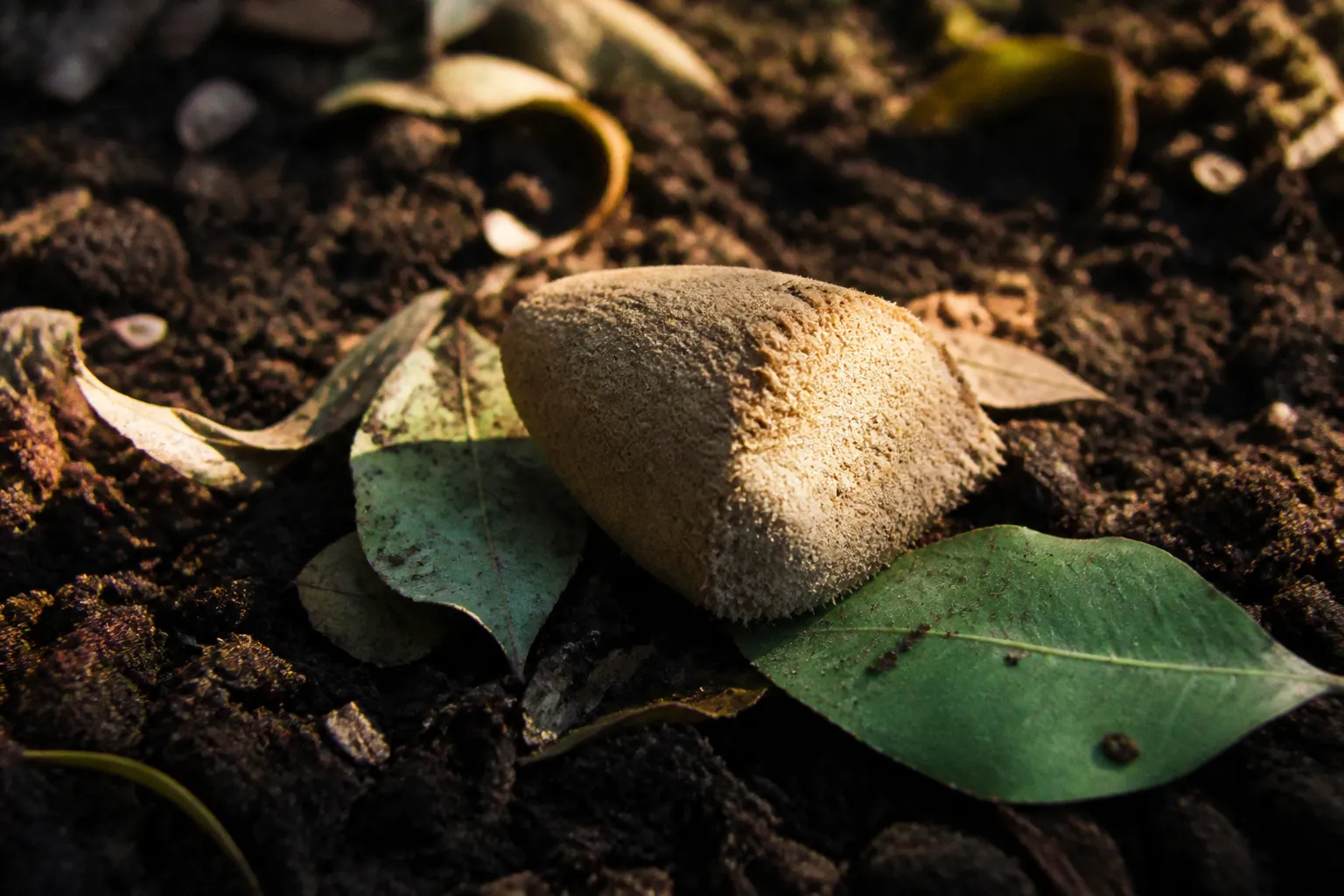
EcoTools and similar brands describe their fully plant-based sponges as capable of breaking down in a home-compost environment within roughly 120 to 180 days. That is the intended end-of-life scenario: a period of use, followed by a move into an active compost system where moisture, air, heat, and microorganisms can act on the material.
The important qualifier is home-compost environment. A landfill is not the same thing as a managed compost bin. A bathroom drawer is obviously not the same thing either. Compostability is a set of conditions, not a claim that the object will vanish wherever it is discarded.
The 120-to-180-day window should be treated as a general range rather than a guaranteed countdown. Compost systems differ in moisture, temperature, aeration, and microbial activity. A dry bin may behave differently from a humid one. A small indoor composting setup may not provide the same conditions as an active outdoor pile. The packaging instructions and the actual composition of the product should guide the decision.
There is also a practical preparation step. Remove as much makeup residue as possible before composting, and check whether the manufacturer allows the product to enter a home compost bin after use. A sponge saturated with foundation, sunscreen, glitter, or other cosmetic materials is not the same object as a clean piece of plant-based foam. “Compostable” does not mean that every ingredient ever applied to the sponge belongs in soil.
What we should not claim is that the sponge will disintegrate in a bathroom drawer, a sealed trash bag, or a landfill. If it is thrown away with ordinary waste, it is no longer receiving the conditions that make home composting relevant. The environmental benefit depends on the disposal route being available and actually used.
For partial-bio options — the 60% sugarcane, 40% polyurethane blends — the lifecycle is more complicated. The renewable component may degrade under suitable conditions, but the polyurethane skeleton remains. That is not the same as full compostability. It can still be a material-reduction strategy, but it should not be marketed or understood as a complete escape from synthetic waste.
| Lifecycle question | Fully plant-based sponge | Partial-bio sponge | Conventional PU sponge |
|---|---|---|---|
| Contains polyurethane? | No, according to the stated formulation | Yes | Yes |
| Intended for home composting? | Yes, under suitable conditions | No, because the PU fraction persists | No |
| Needs cleaning before disposal? | Yes, to reduce cosmetic residue | Yes | Yes |
| Breaks down in a bathroom drawer? | No | No | No |
| Main environmental advantage | A credible composting route after use | Reduced use of petroleum-based material | Durable, but persistent synthetic material |
The lifecycle argument is therefore strongest when it stays narrow and honest. A plant-based sponge does not erase the impact of producing, packaging, shipping, or washing a beauty tool. It does offer a different end point from a petroleum-based foam, provided the user follows the composting instructions and has access to a suitable system.
Cost-Benefit Breakdown: Comparing Bio-Based Tools to Synthetic Alternatives
Let's talk dollars, because the sustainability pitch collapses quickly if the cost structure is unreasonable.
A classic beauty blender retails around twenty dollars. A 100% plant-based biodegradable sponge such as the BioBlender runs roughly $4.99 to $5.99. Partial-bio options sit somewhere in the middle, usually around $8 to $12 depending on the brand and retailer.
The bio-based option is actually cheaper upfront. That is worth flagging because sustainable alternatives often carry a premium. Here, the purchase price can be lower, although the intended replacement cycle is also shorter. Twelve bio-sponges a year at five dollars each comes to about sixty dollars. Twelve classic blenders at twenty dollars comes to about two hundred and forty dollars.
Those annual figures are not a universal ownership-cost calculation. They assume one sponge per month and do not account for sales, multipacks, shipping, professional kit requirements, or a user who replaces synthetic sponges less often. They are useful as a simple comparison of the stated replacement model, not as a promise that every customer will spend exactly that amount.
| Cost metric | Classic PU blender | Plant-based bio sponge | Partial-bio blend |
|---|---|---|---|
| Approximate retail price | ~$20 | ~$5 | ~$8–$12 |
| Illustrative cost at 12 replacements | ~$240 | ~$60 | ~$96–$144 |
| Home composting route | No | Yes, under suitable conditions | No, because PU remains |
| Intended replacement pattern | Varies | About 30 days | Varies |
| Main trade-off | Longer use, persistent material | Shorter cycle, lower-persistence material | Reduced petroleum input, but not fully compostable |
The financial case depends on whether you actually want — and can manage — a monthly replacement rhythm. If you routinely forget to wash tools, a less expensive sponge may make replacement easier. If you use one applicator only occasionally, replacing it every thirty days may feel excessive, even if the material remains physically intact. Sustainability is not improved by buying more products than your routine requires.
There is also a performance cost to consider. A synthetic sponge may retain its shape longer, while a plant-based sponge may offer a more limited but clearly defined working window. For someone who needs one dependable applicator for a professional kit, the most durable option may still be operationally attractive. For someone who prefers a fresh tool and has a composting route, the shorter lifecycle can make sense.
The environmental calculation is similarly conditional. A petroleum sponge that remains in the waste stream for a very long time creates a disposal problem that is easy to ignore because it happens out of sight. A plant-based sponge requires more deliberate behavior: washing it, drying it, replacing it, and putting it in the correct composting system. The trade is not effortless, but it is visible and manageable.
The Verdict
The biodegradable makeup sponge durability test lands in a more interesting place than a simple yes-or-no verdict. Fully plant-based sponges can work as real makeup tools. They provide the soft, seamless blending expected from a damp beauty sponge and can maintain usable structure across the intended thirty-day period. They are not indestructible, and they are not designed to become permanent fixtures in a makeup bag.
The honest version of the performance claim is this: the sponge should remain functional for the planned cycle, while precision, bounce, surface texture, and ease of cleaning may gradually change with use. The exact pace depends on the person using it. There is no responsible reason to promise that every sponge will deteriorate on the same day or that regular washing will preserve it indefinitely.
The practical rules are simple:
- Replace it on a sensible schedule. Thirty days is a useful boundary for a frequently used damp applicator, not a magical expiration event. Retire it sooner if the condition of the material or the smell changes.
- Wash it thoroughly. Plant-based does not mean antibacterial or self-cleaning. Cosmetic residue and moisture remain hygiene concerns regardless of the foam’s origin.
- Dry it in the open. A damp sponge sealed in a makeup bag is difficult to keep fresh and pleasant to use.
- Compost it only as directed. A home-compostable claim applies to the right environment, not to every bin, drawer, or landfill.
- Read the composition. A sponge made partly from sugarcane and partly from polyurethane is not the same as a fully plant-based, compostable tool.
- Match the product to your routine. A monthly replacement cycle makes more sense for regular users than for someone who reaches for a sponge once in a while.
The future of clean beauty application is not necessarily a dramatic rejection of every synthetic tool. It is a more accurate understanding of what each tool is made from, how long it is meant to be used, and what happens when the last layer of foundation has been blended.
A plant-based sponge will not solve the entire waste problem in a makeup bag. It can, however, replace a petroleum-based applicator with a tool that performs for a defined period and has a credible composting route afterward. No miracle claims, no guilt trip — just a shorter lifecycle that works only when the material, the care routine, and the disposal method line up.