Biodegradable makeup sponges: our 30-day durability test
There's a quiet math problem sitting in nearly every bathroom drawer. You bought a pack of three makeup sponges, used them through foundation after foundation, and somewhere around month two the surface started to look a little… off.
The Sponge Question Nobody Wants to Ask
A faint discoloration here. A soft crack there. You rinse, you squeeze, you hope. Eventually, you toss the sponge in the trash, where a petroleum-based foam may remain for years while you move on to the next one.
It's a familiar ritual. And it's the exact moment when a biodegradable makeup sponge starts to look less like a marketing promise and more like a genuinely interesting question: can something designed to break down after disposal actually survive a month of foundation, blending, and daily washing without falling apart in your hand?
That was the question behind our 30-day durability test. We used plant-based makeup sponges through a daily routine, washed them after use, and paid attention to the things that matter at the vanity: softness, bounce, edge definition, surface texture, shedding, and how easily the sponge could be cleaned. The test could show visible wear and changes in performance. It could not, on its own, establish the absence or presence of bacteria inside the foam — a distinction that matters when we talk about hygiene.
The result was more nuanced than either the usual eco-friendly promise or the usual assumption that sustainable tools must be fragile. A well-made plant-based sponge can perform convincingly for a month, but its durability depends on the formulation, the washing routine, and what the word biodegradable actually means on the package.
The Anatomy of Plant-Based Applicators: What's Inside
A traditional makeup sponge is usually polyurethane foam: a petroleum-derived material engineered for bounce, absorption, and that pillow-soft press against the skin. It does its job beautifully. The problem is that its useful life is short compared with its environmental afterlife. Once discarded, polyurethane foam does not simply disappear because the morning routine is over.
Plant-based sponges approach the material problem differently. The better-known formulations use a combination of corn starch, plant biomatter, water, natural colorants, and preservatives intended to keep the product stable during use. The exact proportions and manufacturing process vary, but the basic idea is straightforward: replace a persistent petrochemical foam with a material that can break down under appropriate composting conditions.
That last phrase is important. Plant-based does not automatically mean compostable, and biodegradable does not necessarily describe what happens in every disposal system. A sponge may contain plant-derived material and still include polyurethane, synthetic binders, coatings, dyes, or other components that prevent it from fully breaking down. The front of the box is not enough. The material description and disposal guidance do more useful work.
A genuinely compostable sponge starts with a transparent material story: plant-based components, a clear end-of-life route, and no hidden polyurethane foam.
The distinction also helps separate sustainability from performance. A sponge is not automatically a better tool because it contains corn starch, just as a traditional blender is not automatically a bad tool because it lasts longer in the waste stream. The applicator still has to distribute makeup evenly, survive repeated washing, and remain comfortable on the skin. If it crumbles before the month is over, replacing it twice as often may undercut the environmental benefit you were looking for.
The material changes the feel as well. Polyurethane has a familiar springiness and can feel almost elastic when damp. Plant-based foam is often slightly more velvety and less rubbery. That is not necessarily a weakness. It can create a softer, more controlled press against the skin, but it may take a few applications to understand how much product the sponge wants to hold.
Performance Metrics: Daily Application and Texture Retention
The first question anyone asks about a biodegradable makeup sponge is the obvious one: does it actually work like a regular sponge?
A sustainable applicator that leaves foundation streaky or absorbs half the product is still a poor applicator. The environmental argument cannot compensate for a finish that makes you redo the base twice. For this test, performance meant more than whether the sponge looked intact at the end. We looked at how it behaved when damp, how it distributed liquid and cream formulas, and whether the surface remained consistent after repeated cleaning.
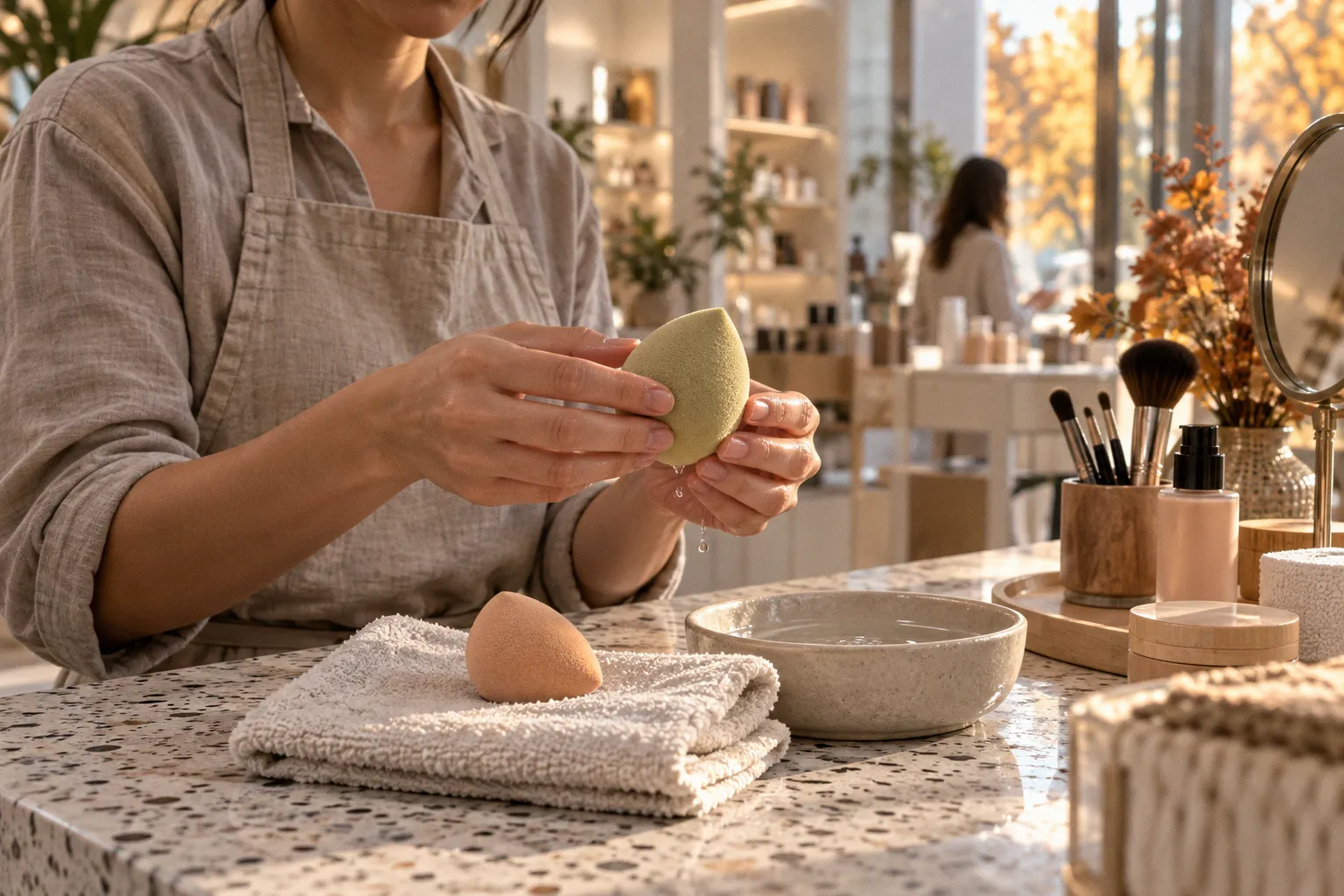
Dampening the plant-based sponge before use changed its behavior immediately. The foam expanded, softened, and became more pliable. Liquid foundation moved across the skin rather than disappearing entirely into the applicator. The rounded side handled larger areas of the face, while the pointed end still reached around the nose and under the eyes. The familiar press-and-bounce technique worked without requiring a completely new makeup routine.
The difference showed up most clearly in texture. The surface felt slightly more velvety than standard polyurethane, closer to soft suede than to memory foam. In practice, that produced a controlled, diffused finish. Coverage built in thin layers instead of arriving all at once, which was useful around the nose and on areas where a heavier application can emphasize texture.
There was also less temptation to drag the sponge across the face. The plant-based foam responded best to pressing and bouncing, not swiping. That is good technique for most makeup sponges anyway, but the surface made the distinction particularly clear. Used correctly, it helped distribute product without leaving obvious edges between the cheeks, jaw, and hairline.
Across the 30-day period, the texture remained broadly consistent. The sponge continued to feel soft when damp, retained its bounce, and did not develop visible bald areas where the foam had worn thin. We also did not observe loose flecks appearing on the skin during application. Those are meaningful durability observations, but they should be described precisely: the test recorded visible condition and application performance, not the microbiological condition of the sponge.
A sponge can look clean and still contain microorganisms inside a damp interior. No visual inspection can prove otherwise. That is why cleaning and complete drying matter even when the foam appears fresh.
What changed — and what did not
The most useful results were not dramatic. There was no sudden collapse at the end of the month and no transformation into a different kind of tool. Instead, the sponge showed how a plant-based applicator behaves when it is treated as a reusable cosmetic tool rather than a disposable novelty.
| Test point | Plant-based sponge after repeated use | What the result tells us |
|---|---|---|
| Dampness and expansion | Softened and expanded for application | The sponge remained functional in the basic wet-use routine |
| Foundation distribution | Blended liquid and cream formulas in thin layers | Performance was comparable to the technique expected from a beauty blender |
| Surface texture | Stayed generally velvety without visible bald patches | No clear visual sign of premature surface wear |
| Edges and pointed tip | Remained usable around detailed areas | Shape retention held up through the test period |
| Visible shedding | No loose flakes were observed during application | The foam did not show obvious breakdown on the skin |
| Hygiene assessment | Appearance and odor were monitored, but no lab analysis was performed | The test cannot prove that bacterial buildup was absent |
That final row is not a footnote to hide. It is part of what responsible durability testing looks like. “Still looks good” and “microbiologically clean” are different claims. The first can be assessed at home or in an editorial wear test; the second requires controlled testing.
The 30-Day Hygiene Cycle and Structural Integrity
Thirty days is a useful point at which to evaluate a makeup sponge because it is long enough to expose repeated washing, drying, and handling. It also sits within the replacement rhythm many makeup users already follow for frequently used cosmetic sponges. The number is not a guarantee that every sponge should be discarded on the same day. It is a practical checkpoint.
The plant-based sponges held up to that checkpoint without obvious structural failure. After a month of daily liquid and cream foundation application, followed by washing and drying, the foam was still soft and intact. The bounce remained usable, the edges had not visibly crumbled, and the surface did not show the kind of deep cracking that makes a sponge difficult to clean or uncomfortable to use.
We also watched for changes that are easy to miss when a sponge is used only occasionally:
- a surface that becomes hard or slick after drying;
- a pointed tip that collapses or splits;
- edge fraying after washing;
- small flakes appearing during application;
- an odor that remains after rinsing and drying;
- makeup staining that keeps spreading through the foam rather than lifting during cleaning.
None of those visible warning signs became a defining problem during the 30-day cycle. That means the sponge retained its shape and function under the conditions of the test. It does not mean the sponge was proven free of bacterial buildup. A visual durability test cannot make that determination, and a clean-looking surface should never be used as a substitute for proper washing and drying.
Thirty days in, the foam was still soft, intact, and usable for blending; visible wear was limited, but microbiological cleanliness would require a separate laboratory test.
The caveat is especially important for a tool that repeatedly contacts liquid makeup, skin oils, water, and air. Even a strong sponge has a damp interior after washing. If it is placed into a closed cosmetic bag or sealed container before it is fully dry, the material can remain wet for much longer than the surface suggests.
Formulation quality matters just as much to structural integrity. A well-made plant-based sponge behaves like a precision tool: resilient enough to compress, soft enough to bounce, and stable enough to survive repeated rinsing. A poorly made version may begin to show micro-tearing after only a few washes, especially if it is scrubbed aggressively or twisted to remove water.
Surface cracking, frayed edges, and tiny flakes are not signs to negotiate with. They indicate that the sponge is no longer performing as intended, whether the cause is weak foam, harsh cleaning, heat, or ordinary wear. At that point, replacing it is more sensible than trying to extract another week from a tool that touches the face every day.
Proper Maintenance to Prevent Premature Degradation
Caring for a plant-based sponge is not complicated. The routine is close to what a traditional sponge requires, but gentleness becomes more important when the foam is designed to be less persistent after disposal.
The goal is to remove makeup without forcing the material to absorb repeated mechanical stress. What worked best during the test was a simple sequence:
1. Rinse soon after use. Run the sponge under lukewarm water before foundation has time to dry deep into the foam. Dried pigment requires more rubbing, and more rubbing means more strain on the surface.
2. Use a mild cleanser. A gentle brush soap or a cleanser made for makeup tools is usually enough for liquid and cream products. Strong solvents, abrasive powders, and unnecessarily harsh formulas can weaken the foam or leave it feeling stiff. The cleanser should remove makeup without becoming the most aggressive part of the routine.
3. Work the product through with pressure, not twisting. Press the sponge between your palms and massage it gently. Twisting stretches the foam unevenly and can create small tears, particularly around the pointed tip and narrow edges.
4. Rinse until the water runs clear. Residual cleanser can change the texture of the sponge as it dries, while leftover foundation can keep the interior damp and make the next wash more difficult.
5. Remove water by pressing. Wrap the sponge in a clean towel or press it between your hands. Avoid wringing it out like fabric. The aim is to reduce excess moisture without pulling the structure in opposite directions.
6. Air-dry it completely. Place the sponge in a ventilated holder or on a clean, dry towel. A closed container is appropriate for storage only after the sponge is fully dry. Putting a wet applicator straight into a makeup bag creates the kind of humid environment that no material can solve by itself.
7. Inspect it before the next use. Look at the tip, edges, and surface. A new crack, persistent odor, unusual tackiness, or visible shedding is a reason to retire the sponge, even if the calendar says the replacement date has not arrived.
The difference between careful handling and rough handling is substantial. A plant-based sponge treated kindly can provide a full month of reliable blending. The same sponge scrubbed hard, twisted dry, and stored wet may begin to degrade much sooner. That is not evidence that every sustainable makeup tool is fragile. It is evidence that the material and the maintenance routine are part of the same system.
There is also a practical balance to strike with cleaning frequency. A sponge used for a full face of liquid foundation should be cleaned after each use. If it is used only for a small amount of concealer, the amount of product may be lower, but the sponge still needs to be cleaned and dried rather than left damp in a drawer. Less makeup does not eliminate moisture, skin contact, or the need for ventilation.
From Vanity to Compost: Understanding the Lifecycle
The end-of-life story is the reason many people look at plant-based applicators in the first place, but it is also where the most careless claims tend to appear.
A sponge should not be called compostable simply because it contains a plant-derived ingredient. The entire product matters: the foam, binders, pigments, coatings, labels, and any other components attached to it. If the packaging lists polyurethane or PU, the sponge is not the same as a fully plant-based foam designed for composting. “Eco,” “green,” and “biodegradable” are not interchangeable technical guarantees.
For a genuinely compostable formulation, the verified disposal route described in the available research is home composting under suitable conditions. In that setting, the foam is documented to disintegrate over approximately 120 to 180 days. That timeframe should not be presented as a universal promise. Compost temperature, moisture, aeration, the balance of materials, and local climate all affect what happens in a home compost system.
In suitable home-compost conditions, a genuinely compostable sponge may break down over roughly 120 to 180 days; that timeline should not be transferred automatically to every municipal green-waste system.
Municipal green-waste programs operate under their own rules and processing conditions. Some accept certified compostable products; others accept only garden waste or food scraps. A sponge that is appropriate for a home compost bin may not be accepted by a local collection service, and a product marketed as compostable may require an industrial facility rather than a backyard pile. The label and the local waste guidance should settle that question.
The sensible sequence is therefore:
- confirm that the entire sponge, not just one ingredient, is identified as compostable;
- check whether the manufacturer specifies home composting or industrial composting;
- remove packaging and non-compostable attachments;
- follow local guidance before placing anything in a municipal green-waste stream;
- do not assume that a stated breakdown period applies in every climate or disposal system.
This is less romantic than imagining the sponge disappearing into a garden on a fixed schedule, but it is more useful. Sustainable disposal depends on conditions. A responsible product makes those conditions clear instead of turning a general environmental benefit into an absolute promise.
There is still a meaningful difference between a plant-based sponge with a documented composting route and a polyurethane sponge with no comparable end-of-life option. The benefit is not that one tool has no impact. Growing, processing, packaging, transporting, and disposing of any product requires resources. The benefit is that a suitable plant-based formulation can reduce the persistence of the material after its useful life — provided it is actually made for that route and sent there correctly.
The Verdict After Thirty Days
So, do biodegradable makeup sponges hold up?
A well-made plant-based sponge performed convincingly across a 30-day daily-use cycle. It blended liquid and cream makeup, stayed soft when damp, retained its general shape, and showed no obvious surface breakdown or shedding during application. For someone comparing an eco-friendly sponge with a traditional blender, the performance gap was not large enough to make sustainability feel like a daily compromise.
The important asterisk is hygiene. The test showed that the sponge remained visibly intact and usable. It did not prove that bacterial buildup was absent. That claim requires microbiological analysis, not a close look at the surface or a lack of odor. The practical response is not to dismiss the material; it is to clean the sponge after use, dry it fully, store it with airflow, and replace it when its condition changes.
The other asterisk is disposal. A plant-based formula is not automatically compostable, and a compostable product does not break down on an identical schedule everywhere. The 120-to-180-day timeframe belongs to documented home-compost conditions, not to every municipal green-waste system or every backyard pile. Read the material information, check the disposal instructions, and treat vague sustainability language with the same caution you would apply to vague skincare claims.
My conclusion after the month-long durability cycle is positive, but not breathless: switch if you can verify the formulation and are willing to maintain the tool properly. The application is there. The softness is there. The lifecycle can be more responsible than that of a conventional polyurethane sponge, but only when the product is genuinely designed for composting and disposed of under the conditions it requires.
That is the more honest version of the sustainable beauty promise. Not a sponge that magically leaves no trace, and not a fragile prop for an eco-conscious bathroom shelf. Just a functional makeup tool with a shorter, more considered afterlife — one that asks for careful use at the vanity and accurate information when it is time to let it go.