Reusable makeup remover pads: material comparison for daily use
The best reusable makeup remover pads are not defined by the prettiest packaging or the word “eco” printed across it.
Reusable Makeup Remover Pads: A Material Comparison for Daily Use
Their real performance comes down to a quieter question: how does the material behave against your skin, your makeup, and your laundry routine?
A soft cotton round may be the right choice for reactive skin but feel underpowered against waterproof mascara. Hemp can handle a heavier cleansing job and last beautifully, yet its denser texture may be too assertive around the eyes. Microfiber removes makeup quickly with very little product, but its synthetic lifecycle raises a different environmental concern. Bamboo terry sits somewhere in the middle, offering softness and absorbency—provided you look closely at how the bamboo was processed.
This reusable makeup remover pads material comparison is designed around those trade-offs. I’m less interested in declaring one fabric universally superior than in finding the material that fits your actual ritual, because a washable pad only reduces waste if you genuinely enjoy using it, washing it, and keeping it in circulation.
Organic Cotton vs. Bamboo Terry: Texture and Sensitivity Profiles
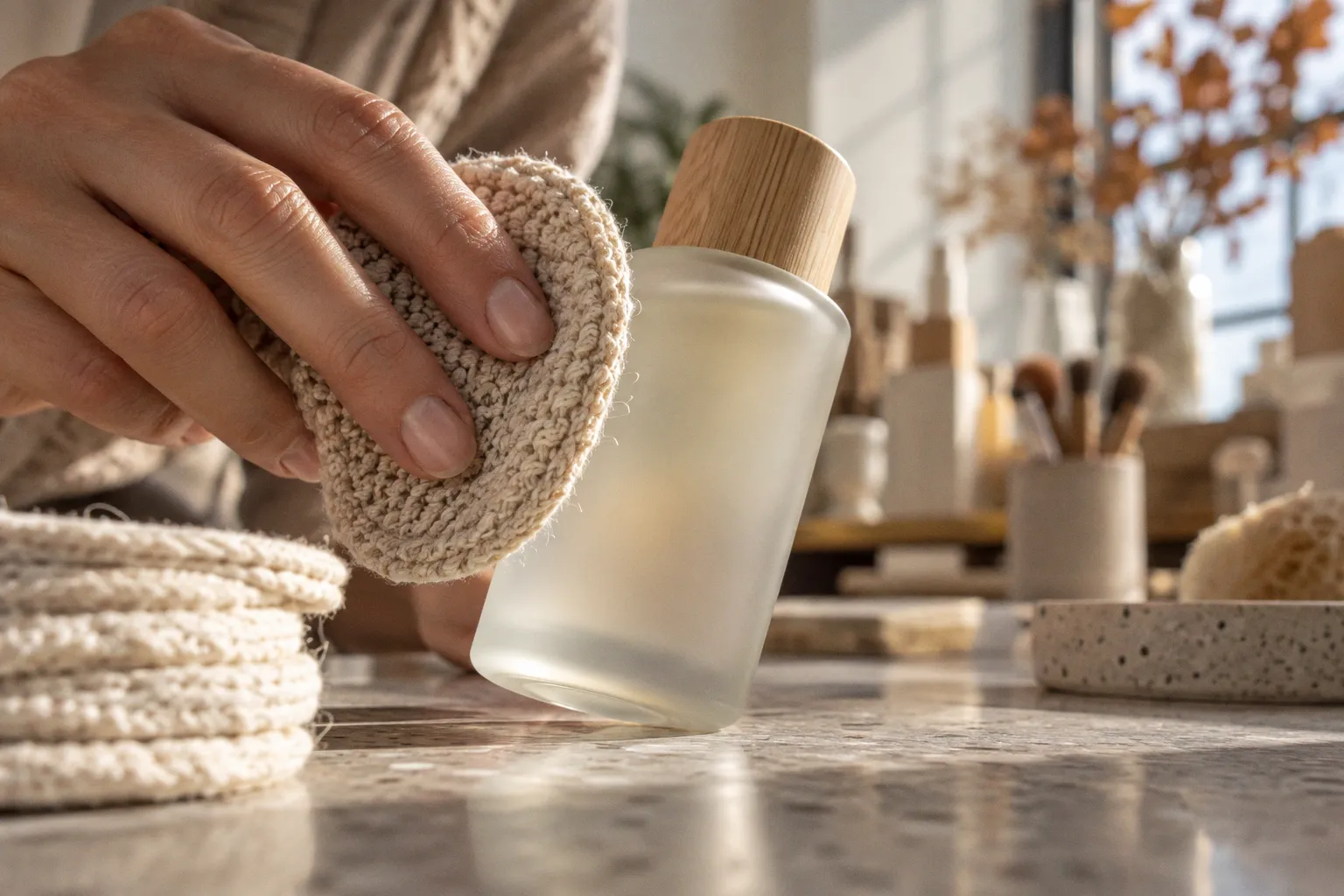
For everyday cleansing, organic cotton and bamboo terry are usually the easiest materials to live with. Both feel familiar, both can be washed and reused, and both work well for removing light makeup, cleanser, toner, or a final trace of foundation around the hairline.
Their difference is in the hand-feel.
Organic cotton has the most recognizable texture: soft, slightly dry, and gentle without feeling slippery. For sensitive or reactive skin, that familiarity matters. The delicate eye area often responds best to a pad that does not drag, catch, or feel overly textured. A smooth organic cotton round can be a comfortable companion for removing concealer, powder, and everyday mascara after the product has been loosened with cleansing balm or micellar water.
Pure organic cotton is not always the most durable option, however. It can soften beautifully over time, but repeated washing and friction may wear down the fibers sooner than a blend or denser weave. That does not make it a poor sustainable choice. Longevity depends on whether the pad is used gently, washed in a mesh bag, and dried without excessive heat.
Bamboo terry feels different. The looped surface creates a plush, absorbent texture that can hold more liquid than a flat cotton round. It is especially pleasant when used with a gentle cleanser or warm water, and it can provide a little more grip when lifting makeup from the cheeks, forehead, and T-zone.
Bamboo is often described as naturally antibacterial and soft, which helps explain its popularity in sustainable beauty tools. But “bamboo” is not a complete description of the textile. Bamboo can be mechanically processed into a more natural fiber, or it can be turned into viscose or rayon using chemical solvents. Those processes have different environmental implications, so an uncertified bamboo pad should not automatically be treated as a fully eco-friendly option.
For skin that flushes easily or becomes tight after cleansing, I tend to favor the least aggressive surface rather than the most absorbent one. A pad should support the cleansing product, not replace it with friction. If you need to rub hard to remove eye makeup, the better adjustment is usually more emulsifying time, more cleansing oil, or a second gentle pass—not a rougher cloth.
The most sustainable pad is the one that removes makeup without asking you to overuse water, cleanser, or friction.
Organic cotton and bamboo at a glance
| Parameter | Organic cotton | Bamboo terry |
|---|---|---|
| Texture | Soft, familiar, usually smooth | Plush, looped, and more absorbent |
| Best suited to | Sensitive skin, eye area, light makeup | Daily cleansing, toner, basic makeup removal |
| Absorption | Moderate to good, depending on weave | Good to high |
| Durability | Good, though pure cotton may wear sooner than blends | Generally resilient, especially in a dense terry weave |
| Environmental questions | Look for organic certification and responsible processing | Verify whether it is viscose, rayon, lyocell, or another process |
| Ideal routine | Gentle, low-friction cleansing | A slightly more substantial washcloth-like ritual |
The diameter also changes how these materials feel in use. Standard reusable rounds are approximately 7–8 cm across, which is enough for a single eye or a small amount of complexion makeup. Larger formats, around 10–12 cm, offer more surface area for removing foundation or a face mask and can be easier to hold if you prefer fewer passes.
For sensitive skin, size is not merely a convenience detail. A larger pad can reduce the temptation to keep using the same small, saturated area across your face. A clean, generous surface makes the ritual feel more seamless and can limit unnecessary pressure.
Why Cotton Is Not Always the Gentlest Choice
“Cotton” covers a wide range of constructions. A thin, tightly woven round, a fluffy terry pad, and a cotton-hemp blend may all be sold under the same broad label while behaving quite differently.
Flat cotton is usually the easiest to control around the eyes. It absorbs enough product to work with micellar water or toner without becoming bulky. The downside is that thin pads may become saturated quickly, especially when removing long-wear foundation or several layers of eye makeup. Once the pad is wet and loaded with pigment, continuing to use it can spread rather than lift residue.
A thicker cotton terry pad can feel more substantial, but the loops may create additional drag on dehydrated skin. This is not necessarily a problem for the cheeks or jawline, yet the eye area often benefits from a smoother surface. In my approach to cleansing, the material should become softer and more pliable after washing, not rougher. A pad that dries stiff or develops a scratchy edge is no longer serving the skin well, no matter how sustainable its original fiber was.
Organic certification can help narrow the field. GOTS, or the Global Organic Textile Standard, addresses more than the source fiber and can provide information about processing and manufacturing requirements. OEKO-TEX Standard 100 is useful for checking whether the finished textile has been tested for certain harmful substances. These certifications do not guarantee that a product will be perfect for your skin or that its entire lifecycle is impact-free, but they offer more substance than vague claims such as “natural” or “green.”
The Durability of Hemp Blends for Heavy-Duty Makeup Removal
Hemp is the material I would look toward when the cleansing job is more demanding. Its fibers have a denser, coarser weave, which gives hemp pads a level of durability that softer fabrics may lack. They are particularly effective for removing heavier makeup, face masks, and waterproof mascara once the product has already been broken down by an oil cleanser or balm.
That last part matters. A durable pad is not a substitute for proper makeup dissolution. Waterproof formulas are designed to resist water, and no textile should need to be dragged repeatedly across the eyelid to defeat them. Apply the cleansing product, allow it a moment to work, then use the hemp pad to lift the softened residue. This makes the process more comfortable and protects the pad from becoming needlessly stained.
Hemp’s denser structure can be useful on the rest of the face, particularly around the nose, chin, and jaw where foundation and sunscreen tend to collect. It also holds up well when used to remove a clay or cream mask. In that role, the pad becomes part of a broader cleansing ritual rather than a disposable replacement for every cotton round.
The trade-off is tactile. Hemp is not usually the first choice for highly reactive skin or the delicate eye area. Even when the fabric is blended with a softer fiber, it may feel more textured than organic cotton or bamboo terry. If your skin barrier is compromised, you have active irritation, or you are prone to redness, the extra grip that makes hemp effective elsewhere may simply be too much.
Where hemp makes the most sense
- Removing rich foundation, long-wear complexion products, and face masks after they have been loosened with cleanser.
- Supporting a low-waste routine for someone who prefers a durable, substantial textile over a very soft round.
- Cleaning the neck, jawline, and T-zone, where a little additional texture can help lift residue without repeated passes.
- Pairing with a separate, smoother pad for the eyes and areas of sensitivity.
A hemp blend can be a strong choice for longevity, but durability is not the same as guaranteed lifespan. Manufacturers may describe reusable pads as lasting hundreds or even more than a thousand uses, yet there is no single standardized number of wash cycles that applies to every textile, seam, detergent, or drying method.
In practice, the lifecycle is shaped by care. A pad washed hot, dried aggressively, and left damp in a closed container will age differently from one rinsed promptly, laundered gently, and allowed to dry fully. Sustainable beauty becomes much more convincing when we look at the entire routine rather than treating the material label as a shortcut.
Microfiber Efficiency and the Reality of Synthetic Shedding
Microfiber is the most efficient material in this comparison if efficiency means lifting makeup quickly with minimal product. Its very fine fibers can catch pigment, oil, and residue with surprising speed. For someone who wants to remove makeup with water or a small amount of cleanser, microfiber may feel almost effortless.
That performance is precisely why microfiber remains popular. It is smooth, lightweight, quick to dry, and often effective at removing foundation without requiring a thick layer of cleansing product. In a busy routine, those qualities are genuinely convenient.
But microfiber is petroleum-derived synthetic fiber, and its environmental profile cannot be separated from that fact. During machine washing, synthetic textiles can shed microplastics. A microfiber pad may replace a large number of disposable cotton rounds, but that does not make it a zero-waste material or an uncomplicated sustainable choice.
This is where the phrase “eco-friendly makeup removal tools” needs a little precision. Reusability is one part of the picture. Fiber source, manufacturing, washing, drying, and end-of-life disposal all belong to the pad’s lifecycle. A product can be highly reusable and still create another type of environmental burden.
Microfiber vs. organic cotton pads
| Parameter | Microfiber | Organic cotton |
|---|---|---|
| Makeup removal speed | Very fast, especially for light to medium makeup | Steady and gentle, often needing more product |
| Product use | Can work with a small amount of cleanser or water | Usually benefits from micellar water, oil, or cleansing balm |
| Skin feel | Smooth and efficient, though personal tolerance varies | Soft and familiar, particularly for sensitive skin |
| Wash-related concern | Potential microplastic shedding | No synthetic microfibers, but cotton still requires water and energy to wash |
| Best use | Quick makeup lifting when efficiency is the priority | Daily gentle cleansing and eye-area use |
| Sustainability profile | Reusable but petroleum-derived | Plant-based fiber; certification and cultivation still matter |
If you already own microfiber pads and they work well for you, the most thoughtful approach is not necessarily to discard them immediately. Continued use extends the value of the item already made. Wash them in a way that limits fiber release, such as using a laundry bag designed to capture synthetic fibers, and avoid replacing them simply because another material has a more appealing label.
If you are choosing from the beginning and your priority is reducing synthetic textiles, organic cotton, hemp blends, or responsibly processed bamboo may align more closely with your values. The right decision depends on the balance you are trying to create between skin comfort, makeup performance, washing habits, and material footprint.
Navigating Greenwashing in Bamboo Textiles
Bamboo is one of the most confusing materials in the sustainable beauty category because the raw plant and the finished textile are not always environmentally equivalent.
Bamboo grows quickly and is often presented as a naturally low-impact crop. But many bamboo textiles used in beauty products are bamboo viscose or rayon. Producing these fibers involves chemical solvents such as carbon disulfide and sodium hydroxide. That does not make every bamboo viscose product unacceptable, but it does mean the word “bamboo” alone cannot tell you enough about the manufacturing process.
When comparing bamboo pads, I look for more specific language:
- Is the textile bamboo viscose, bamboo rayon, bamboo lyocell, or mechanically processed bamboo?
- Does the brand explain the manufacturing process rather than relying on plant-based imagery?
- Is the fiber certified under a recognized standard?
- Does the product identify the source of the bamboo?
- Are the pad edges securely finished, with stitching that can tolerate repeated washing?
FSC certification can help verify the source of bamboo, but it does not answer every question about how the raw material became fabric. GOTS and OEKO-TEX may provide additional information depending on the product and the claims being made. No single logo transforms a textile into a perfect environmental choice, yet transparent documentation is a much stronger signal than a leaf illustration or the phrase “earth-friendly.”
This is also where packaging can distract from performance. A reusable pad sold in a cardboard box may still be poorly made if the stitching unravels after a few washes. Conversely, a simple product with modest packaging may serve you for years if it has a practical shape, resilient seams, and a fabric that suits your skin.
I would rather see a clear description of fiber content and care instructions than a broad promise of guilt-free beauty. Sustainability should make the routine more considered, not more anxious.
A material claim is only useful when it tells you how the fiber was made, how it should be washed, and how long you can realistically keep using it.
Sizing, Shapes, and the Daily Cleansing Ritual
The standard 7–8 cm round is the most versatile format for everyday makeup removal. It fits comfortably in the hand, works around the eyes and nose, and can be stored easily in a small wash bag. For light complexion makeup, one or two rounds may be enough when paired with an effective cleanser.
Larger 10–12 cm pads are better for removing foundation across the face, wiping away a mask, or cleansing the neck. They can also be useful if you prefer a washcloth-like experience. The extra surface area means you can fold the pad and use different sections rather than repeatedly returning to the same stained area.
Shape affects control. Rounds are easy to rotate and are especially convenient for the eye area. Square or rectangular pads may provide more usable surface, particularly when folded, but they can feel less precise around the lash line. Some pads have a smooth side and a textured side. This can be helpful if the smoother side is reserved for sensitive areas and the slightly more absorbent side is used on the cheeks or forehead.
A practical daily system might look like this:
1. Loosen makeup before reaching for the pad. Use cleansing balm, oil, micellar water, or another suitable remover and give it time to dissolve long-wear products.
2. Start with the cleanest area. I prefer moving from the eye area to the rest of the face only when the pad is still clean enough to lift rather than smear.
3. Use light pressure. The pad should glide. If it catches, add more product or switch to a softer surface.
4. Separate used pads promptly. A ventilated wet bag is preferable to leaving damp textiles in a sealed container.
5. Wash according to the fiber. Follow the manufacturer’s instructions, use a mesh bag when appropriate, and avoid fabric softener if it coats the fibers and reduces absorbency.
6. Dry completely before storage. Full drying supports freshness and preserves the pad’s useful lifecycle.
The temptation with reusable products is to buy a large set and assume quantity equals sustainability. In reality, a smaller rotation that you consistently wash may be more sensible than a drawer full of unused pads. You need enough to move comfortably through your routine between laundry days, but not so many that the product becomes invisible in your storage.
For a mixed makeup routine, combining materials can be more effective than insisting on one universal fabric. For example, organic cotton or smooth bamboo terry can handle the eye area, while hemp can take on heavier face makeup or masks. Microfiber can remain in service if you already own it and are comfortable managing the synthetic fiber issue. Sustainable choices do not have to be perfectly uniform to be meaningful.
My Verdict: Which Reusable Pad Material Is Best?
For most people, organic cotton is the safest starting point in this reusable makeup remover pads material comparison. It has a familiar texture, works well for sensitive or reactive skin, and feels gentle around the eyes when the weave is smooth. Choose a well-finished pad, preferably with credible organic or textile-safety certification, and expect it to perform best with a cleanser that has already loosened makeup.
Bamboo terry is my choice for a soft, absorbent daily cleansing ritual. It is especially pleasant for basic makeup removal and T-zone cleansing, but I would not buy it based on the word “bamboo” alone. Check whether the product is viscose, rayon, lyocell, or another form of processing, and look for meaningful certification or manufacturing information.
Hemp blends are the strongest option for durability and heavier cleansing work. They are useful for masks, waterproof mascara after proper dissolution, and areas where a denser fabric helps lift residue. They are less likely to be the best choice for delicate, reactive skin or repeated eye-area use.
Microfiber wins on speed and minimal product use, but not on a straightforward sustainability profile. It remains a practical reusable tool, particularly if you already have it, yet petroleum-derived fibers and microplastic shedding should be part of the decision.
The most balanced setup is often not a single “perfect” pad but a small, intentional rotation: a smooth material for sensitive areas, a more durable textile for heavier work, and a care routine that preserves both. Reusable beauty tools earn their place through longevity. Wash them gently, let them dry fully, retire them when the surface becomes rough or the seams fail, and choose the next material with its complete lifecycle in mind.
That is how a makeup removal ritual becomes genuinely lower-waste: not through a flawless label, but through a tool that feels good enough to use every evening and well made enough to stay with you.